Smithsonian’s New ‘First Do No Harm’ Exhibit Is a Must-See for Every Nurse
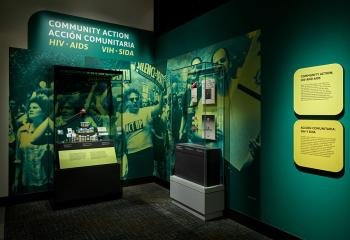
The Smithsonian’s National Museum of American History has opened “First Do No Harm,” a new exhibition about science, medical practice and public health that puts some of the most famous objects in American medicine in one gallery in Washington, D.C.
The exhibition opened to the public on Friday, November 6, 2026. On display are a sample of Alexander Fleming’s original penicillin mold, a syringe Jonas Salk used to test the polio vaccine, and the first artificial heart ever implanted in a human. The museum says the show looks at “both the triumphs and the shortfalls of the medical system” and how both have shaped Americans’ health.
Most notably for nurses, the shoes Sandra Lindsay wore while caring for patients during the COVID-19 pandemic are on display. Lindsay, a critical care nurse in Queens, became the first person in the U.S. to receive an authorized COVID-19 vaccine outside of clinical trials on Dec. 14, 2020. In 2022, she received the Presidential Medal of Freedom, the nation’s highest civilian honor.
It’s also a story about the nursing profession: the people at the bedside who have tried for generations to live up to the oldest promise in healthcare.

Want to see more Nurse.org articles in your Google results? Add us as a preferred source.

The exhibition is named for the ancient principle that guides clinical practice. According to the museum’s visual description of the gallery, the entrance text reads: “Health care practitioners, inspired by the ancient charge to ‘first, do no harm,’ have advanced medicine to improve patients’ lives.”
The museum says the exhibition “explores the efforts of health practitioners and others to reduce suffering, extend lives, and provide better healthcare for all.”
Its signage is bilingual. The full title is First Do No Harm/Lo primero es no hacer daño.

The show had been a long time coming. The museum’s exhibition page had listed it as postponed before it finally opened this month.

First successfully implanted total artificial heart, 1969
Visitors start with three case studies:
- Maurice Hilleman, PhD, the scientist who helped develop some 40 vaccines
- The 1985 Report of the Secretary’s Task Force on Black and Minority Health, commissioned by Health and Human Services Secretary Margaret Heckler. The museum describes it as the first time the federal government acknowledged racial and ethnic health disparities in the United States
- San Francisco’s Chinese Benevolent Association, which opened the Tung Wah Dispensary in 1899 to care for a community shut out of the city’s hospitals
Each case study contains an adjacent panel that poses a question to consider as visitors move through the exhibit.
Part 1
Hilleman developed the mumps vaccine from a virus sample he took from his 5-year-old daughter, Jeryl Lynn, when she came down with mumps in 1963. The vaccine was licensed in 1967, and the Jeryl Lynn strain is still used in today’s MMR vaccine. On display is a two-foot-tall metal cylindrical canister with a turquoise-green rubber stopper that contained the seed stock.
There are also several pictures of Hilleman in a lab coat as well as other scientists in lab coats holding chicken eggs being used to develop a flu vaccine.
Question: How have advances in medicine affected your life?
Part 2
The 1985 Report is an eight-volume report with the first paperbound volume on display. It is more than 250 pages with a beige cover. Photographs are also in the case including a 1985 photo of Heckler and task force chair Thomas Malone, PhD.
Other photos show hospital emergency rooms, which were often the only source of care for many minority patients.
Question: How has who you are or where you lived shaped the health care you’ve received?
Part 3
The last case study starts with the statement: “Responding to gaps in care, community advocates are among those who have sought ways to make the nation and the world healthier for all.”
The display case contains traditional Chinese medicines in three tall clear-glass jars as well as black and white photographs from the 1900s showing association members posing in front of the dispensary. Other photos include frontier nurses in Eastern Kentucky in 1930, the Black Panther Party’s free clinic in 1969, and a community health fair in Miami in 2006.
Question: How have you or members of your community sought to make a healthier world?
Past the case studies, the core of the exhibition covers health data, medical technologies, and changing understandings of microbes and germs.
Penicillin Mold, Salk’s Syringe and the First Artificial Heart
Anthea M. Hartig, the museum’s director, calls the exhibition “a dynamic showcase of some of the most significant artifacts in the museum’s collection.” Highlights include:
- The Liotta-Cooley artificial heart, the first ever implanted in a human, in 1969
- A sample of penicillin mold from Alexander Fleming’s original culture, which Fleming gave the Smithsonian in 1953
- A syringe Jonas Salk used in early polio vaccine tests in 1952 and 1953
- A vial from the first Pfizer-BioNTech COVID-19 vaccine doses given in the U.S.
- A prototype scanner that Allan M. Cormack used in 1963 experiments related to CT scanning
- HIV and AIDS drugs from the 1980s and early 1990s

Syringe Jonas Salk used when testing polio vaccine
The exhibition doesn’t present these advances as simple wins. The museum’s online companion describes how, by the 1940s, penicillin and other antibiotics became “wondrous weapons against germ enemies,” in a section titled “Learning to Live With Microbes.” That’s a familiar idea for any nurse who has worked under antimicrobial stewardship rules. Another section covers efforts in the mid-1800s to early 1900s to measure and define an “ideal” or “normal” body. A third looks at how tracking disease became more routine and systematized in the early 1900s.
“First Do No Harm” is on the second floor, east wing of the museum at 1300 Constitution Ave. NW. Admission is free and no passes are required. The museum is open daily from 10 a.m. to 5:30 p.m. and closed December 25. The exhibition will be on view for about three years.
Nurses deal with the history in this exhibition every shift. The vaccines nurses give, the infection control they practice, and the disparities they see in their patients all trace back to the stories on display.
A few takeaways for nurses:
- “Do no harm” is a nursing value, too. The exhibition credits “health care practitioners,” not just physicians, with advancing medicine. That includes the nurses who gave the vaccines, staffed the wards and carried out public health campaigns.
- Health equity has a long history. The case studies on the 1985 Heckler report and the Tung Wah Dispensary show that disparities in care, and community efforts to close them, go back well over a century. Nurses working in underserved settings will recognize that story.
- Progress has side effects. The exhibition’s framing of antibiotics, data and new technology is a reminder that innovation brings new risks. Nurses at the bedside are often among the first to see those risks play out.
- It’s free and it’s staying put. If you’re heading to D.C. for a conference, a board meeting or a vacation, the exhibition is expected to stay up for about three years.
🤔 If you could add one nursing artifact to the Smithsonian’s “First Do No Harm” exhibition, what would it be and why? Tell us in the comments!
If you have a nursing news story that deserves to be heard, we want to amplify it to our massive community of millions of nurses! Get your story in front of Nurse.org Editors now – click here to fill out our quick submission form today!