Nurse Elaine Turned Her Calling Into Mission Trips for Nurses—And Yes, There’s Fun Too
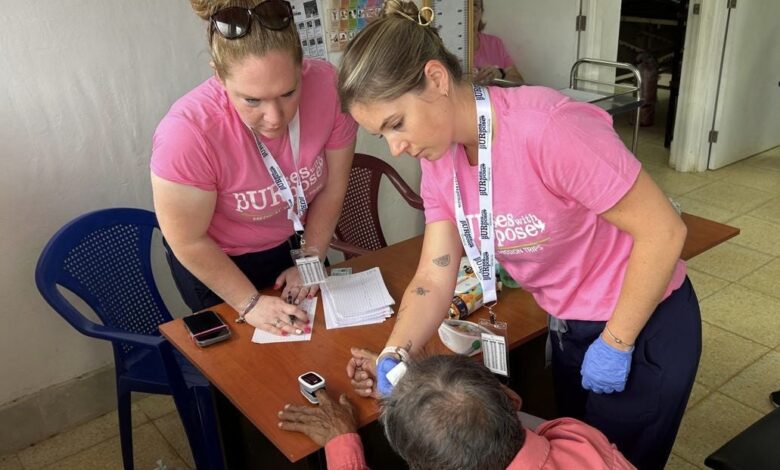
If you’ve ever felt the call to travel abroad and serve others with your nursing degree—with a little fun for you thrown in—Nurses with Purpose has just the solution for you. The registered 501(c)(3) is a volunteer organization that organizes preventive healthcare programs through medical missions and provides nurses with cultural learning experiences.
It’s the first nurse-created and nurse-driven mission trip organization of its kind, and Nurse.org got a chance to hear from Nurses with Purposes founder and executive director Elaine Alston, LPN, to find out just how nurses can get involved.

Alston, who became a nurse in her early 30s, tells Nurse.org that her nursing school program included a requirement to volunteer four hours in the hospital every single week. As any busy nursing student—and especially one who already happened to be a mom—would feel, Alston shares that she wasn’t initially excited about the prospect.
“The thought of ‘wasting’ 4 hours passing water pitchers and saying ‘hi’ to patients was the last thing I wanted to do when I could have been studying,” she admits.
But what started as something she would dread soon became something she found “replenished” her.
“Hearing war stories, grannies talking about their childhood, and people saying, ‘You’re going to be a great nurse,’ made that burden the best part of my day,” she says. “This made me eager to volunteer more throughout my community. I fell in love with the power of giving back, which could go on to become the Nurses with Purpose mantra.”
With that seed for giving back planted, Alston took a trip in 2010 to her native land of Johannesburg, South Africa, and realized that she wanted to give back to the country she “instantly fell in love with.”
On that same trip, Alston discovered that her grandmother (her ‘Gogo’) had also been a nurse who had dedicated her life to caring for others.
“People would say, ‘You have the same mannerisms as your grandmother—she would bring strangers in the house to care for them,” Alston says.
Hearing stories of her grandmother’s work as a nurse, Alston adds, not only “comforted and encouraged” her, but she also soon realized that her drive to establish a mission-trip-based organization was also part of her grandmother’s legacy.
“I would have never in a million years had enough courage to do something like this,” she notes.

Connecting with her homeland and family legacy of nursing and serving ignited a fire in Alston, so she says she began “to walk” and serve those in need.
The grassroots development of Nurses with Purpose never intended to become a full-fledged organization, she notes, but ” heart, drive, and intentional purpose lead the organization for steady growth. Nurses with Purpose, Inc. was established in 2017, hosting merely one mission trip per year, to now serving throughout the globe with multiple missions a year.

Alston is proud of the organization’s growth as well as the personal satisfaction it allows for in bringing the spirit of nursing ot life.
“I love seeing people heal,” she says. “I love seeing people thrive with the nursing care I give, which allows them to be comfortable wherever they are in their transition of life.”

Nurses with Purpose organizes mission trips abroad with the goal of creating preventive healthcare programs and long-term partnerships in areas that can benefit from community growth and involvement.

And while each trip is designed to improve local people’s health, Alston explains that they are also designed to be “well-balanced” missions, benefiting both patients and nurses. To accomplish that, each mission is structured to include several days of volunteer service in various settings, followed by a few days infused with exciting excursions, learning about the culture, and fun activities.
Here is just a sampling of some of the mission trips Nurses with Purpose has planned:
While each trip is different, a sample itinerary on a Nurses with Purpose mission trip includes primary and preventative healthcare services that include walk-in clinics, school, and home visits, lodging, and of course, fun.
For instance, here’s a recent itinerary from the South Africa trip:
- Impactful service providing Primary & Preventative Healthcare services (no acute care)
- Working in villages, schools, townships, and home visits
- Airport transfer
- Accommodations (2-bedroom apartment shared with common spaces, full kitchen, living room & patio)
- 1 overnight stay at a 4-4.5 star private game lodge while on Safari
- Try to spot the BIG 5 on a scenic safari drive with the rangers.
- Go back in time and learn about the tribes of South Africa with a cultural village tour that has traditional drumming, dance, and storytelling
- Lion Park & Safari Tour, along with & giraffe feeding
- Local markets and Art Gallery stops
- Market shopping

Sound like something you’d be interested in? Alson encourages anyone interested and new to Nurses with Purpose to join their monthly conference call to learn more, as the call goes over all the information you would need to know.
You can also browse the available 2026 trips, keeping in mind that she does recommend that first-timers consider the South African Signature trip as a good starting point.
If you’re a nursing student, you also have a chance at nabbing the Emilia Foundation Sponsorship, an annual scholarship named after Alston’s grandmother. The sponsorship allows one traditional or LPN-RN bridge student to attend a mission trip upon graduating and passing the NCLEX. And the organization is currently looking to start an LA-based chapter, so if you’re an LA nurse looking to get involved, reach out!
At the end of the day, whether at the bedside or serving on a mission abroad, Alston hopes that her work helps nurture tangible growth of healthy communities. And she encourages each and every nurse she works with to be “mentally and spiritually ready” before a trip, as she warns you may encounter “touching and sensitive cases.”

She shares, for instance, a home visit the Nurses with Purpose team made for a woman who was not able to physically travel to the clinic. The woman was shocked when a team of nurses walked into her home.
“Eyes wide, her jaw dropped, and she gently grabbed my hand and said, ‘Thank you for making me feel like a human being.'”
Learn more about Nurses with Purpose on their website and follow them on TikTok, Instagram, and Facebook.
🤔Nurses, what do you think about this lawsuit? Share your thoughts below.