Weapons Detectors Are Coming to Every Hospital in California, Under New Law

A California law passed in 2024 is about to change what it feels like to walk into a hospital. Under Assembly Bill 2975, every licensed general acute care and psychiatric hospital in the state must install automated weapons detection systems at three specific entrances, and the clock is ticking faster than many facilities realize.
Cal/OSHA is required to finalize the specific compliance standards by March 1, 2027. From that point, hospitals will have just 90 days to achieve full compliance. For the more than 400 California hospitals that fall under the law, that’s a very narrow window — especially when you factor in the time it takes to evaluate vendors, issue procurement requests, install equipment, train staff, and document everything for inspection.
The law mandates automated weapons detection, not just handheld metal detector wands, at three entry points:
- The main public entrance
- The emergency department entrance
- The labor and delivery entrance if it is separately accessible to the public.
Handheld wands can still be used as a secondary tool, but they cannot be the primary screening method for most hospitals. Exceptions exist for small and rural hospitals and facilities with structural limitations that prevent installation of larger systems.
Critically, the law specifies that weapons screening must be staffed by non-clinical personnel, not nurses or doctors. Those designated employees must complete a minimum of eight hours of training covering device operation, de-escalation techniques, and implicit bias before they can implement the screening policy. Hospitals must also develop written policies covering what happens when a weapon is detected, how to handle individuals who refuse screening, and how to document compliance for Cal/OSHA inspections.


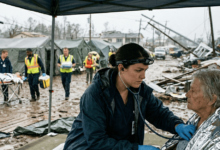

There’s also an important federal layer: EMTALA, the federal law requiring hospitals to provide emergency care to anyone who needs it, supersedes the state screening mandate. Hospitals must post visible notices at all screened entrances stating that no one will be refused medical care, and “treated-first, screened-later” protocols are required for emergency patients who need immediate attention.
Workplace violence against nurses is not a new problem — one in four nurses faces physical assault on the job, according to industry data. AB 2975 is California’s most significant legislative response to that reality to date, and it has direct implications for how hospitals are staffed, secured, and operated.
For nurses specifically, the law brings some relief: you won’t be pulled into screening duties. But it does mean your workplace is about to change in visible ways, with new checkpoints, new security personnel, and new protocols at the doors you walk through every shift. The law also requires hospitals to address how clinical authority and security protocols interact when a patient needs immediate care, which is a conversation that nurses on the floor will likely be part of.
Experts warn that hospitals waiting for Cal/OSHA to finalize the specific standards before acting may find themselves in a last-minute scramble competing with hundreds of other facilities for the same vendors and installation teams. The facilities best positioned for smooth compliance are the ones planning now — in 2026 — not 2027.
AB 2975 applies to all California hospitals licensed under Health and Safety Code Section 1250(a), (b), or (f) — with the exception of state-operated psychiatric and correctional facilities. If you work at a qualifying hospital in California, weapons screening at your facility’s main entrance, ER, and labor and delivery is coming, whether your hospital is ready or not.
The law does not require hospitals to confiscate or store weapons — individuals who are found with a weapon must be given the opportunity to leave and re-enter without it. And if your hospital hasn’t started planning yet, now is a good time to ask leadership where things stand.