Can Online Education Help Solve America’s Nursing Crisis?
This is an opinion article, contributed by: Nancy Bellucci, Ph.D., MSN, MS, RN, CNE, CNOR (academic program director, College of Nursing and Health Sciences at Columbia Southern University)
The question sounds provocative, even unsettling: Can you really train a nurse online?
For a profession rooted in hands-on care, human connection, and clinical judgment, the idea can feel like a contradiction. But this is no longer a theoretical debate. It is a practical one, and it sits at the center of one of the most urgent challenges facing health care today.
The United States is not just facing a shortage of nurses. It is facing a shortage of nurse educators.
In 2024, more than 80,000 qualified applicants were turned away from nursing programs, largely because of faculty shortages. This is the bottleneck few outside the profession are talking about, and one that threatens to stall progress on the broader workforce crisis. If we cannot teach more nurses, we cannot solve the shortage.

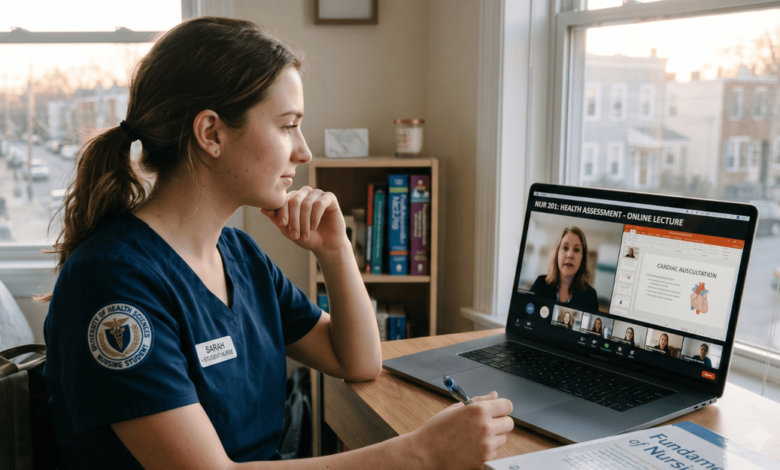
That is why digital clinical education is emerging not as a workaround, but as an evolution. Online nursing education is often misunderstood as a replacement for hands-on learning. It is a rethinking of how nurses – and critically, nurse educators – are prepared. At its best, it blends technology, pedagogy, and evidence-based teaching into a model that is more flexible, more scalable, and more intentional than traditional approaches.
The shift accelerated during the COVID-19 pandemic, when in-person clinical placements were limited and programs had to adapt quickly. What began as a temporary solution has since revealed something more durable: Digital tools, when used thoughtfully, can expand access without compromising rigor.
More importantly, they can help address the educator gap.
Programs such as RN-to-master’s and graduate pathways in nursing education are designed not just to produce clinicians, but to prepare educators – professionals who can teach, mentor and lead across classroom, clinical and hybrid environments. That distinction matters.
The real innovation in online nursing education is not simply where learning takes place, but how teaching itself is approached. These programs place greater emphasis on instructional design, learning theory and evidence-based teaching strategies, areas that historically received less attention in clinically focused graduate education. Students learn not only what to teach, but how to teach effectively across diverse learning environments, including online and hybrid settings.
>>Listen to The Latest Nurse News Podcast
Simulation, virtual case studies and structured digital assessments allow educators to create consistent, measurable learning experiences. These tools can expose students to complex clinical scenarios they might not encounter during limited clinical rotations while also providing immediate feedback that strengthens clinical judgment.
Critics argue that online education risks diluting quality. But when grounded in strong pedagogy, the opposite can be true. Digital platforms can enhance accountability, enabling educators to track outcomes in real time and ensure students meet clearly defined competencies.
The reality is this: The nursing shortage is not just a workforce issue. It is an education infrastructure problem.
There are not enough faculty, not enough clinical placements and not enough accessible pathways for working nurses to transition into teaching roles. Online and hybrid programs help address these barriers by allowing nurses to advance their education without leaving the workforce or relocating. In doing so, they expand the pipeline of future educators.
Online education alone is not the solution. Nursing will always require hands-on training, supervised clinical practice and human interaction. The goal is not to replace these elements, but to integrate them more effectively with modern tools and teaching strategies.
The better question, then, is not whether nurses can be trained online.
It is whether we can afford not to modernize how we educate them and those who teach them.
At a time when health care systems are under strain, workforce shortages persist and patient needs are growing more complex. Maintaining the status quo is not a sign of rigor; it is a risk.
If we want more nurses at the bedside, we must first invest in those who are standing in front of the classroom.
Nancy Bellucci, Ph.D., MSN, MS, RN, CNE, CNOR, is the academic program director for the new College of Nursing and Health Sciences programs at Columbia Southern University.
🤔 Nurses, share your thoughts in the comments below.
If you have a nursing news story that deserves to be heard, we want to amplify it to our massive community of millions of nurses! Get your story in front of Nurse.org Editors now – click here to fill out our quick submission form today!
-
Published on
May 19, 2026
Written by
Nurse.org Staff