Nurse Beaten by Patient in Jackson Memorial ER Sues for $5 Million as Video Is Released

Newly released surveillance video shows a patient chasing and striking workers in the Jackson Memorial Hospital emergency room on May 30, then repeatedly punching nurse Yanira Eguileor and knocking her to the floor before staff pulled him away.
Eguileor is suing the hospital and Miami-Dade County for $5 million, alleging inadequate security. Her attorney, Michael Pizzi, says the public is only seeing the video because he filed a second lawsuit to force its release.
For too long, violence against nurses has happened behind hospital walls, witnessed by coworkers but largely invisible to the public. Making incidents like this visible matters. We cannot fully understand the scope of workplace violence in healthcare, identify patterns, or determine which interventions are actually working if these incidents remain hidden or inconsistently documented. Every report we make, every piece of data, and every story that reaches the public builds a clearer picture of what nurses are facing at work.
Want to see more Nurse.org articles in your Google results? Add us as a preferred source.



The footage shows the patient, identified as 44-year-old Wenyou Rubin, chasing another worker through the ER and striking a financial services staffer, Tisa Wolf, before turning on Eguileor. Eguileor said she stepped in when Rubin was about to hit a colleague. “It was a total of three bashes to the head,” she told WSVN.
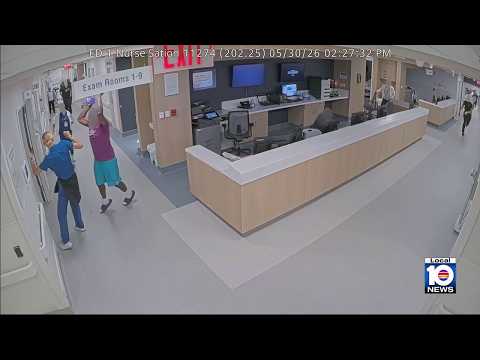
Pizzi says the attack left Eguileor, a career trauma nurse, semi-unconscious on the floor, with injuries to her head, neck, spine, and back that required CT scans.
What constitutes adequate protection for nurses when a hospital knows it’s caring for patients who may present a violence risk?
The $5 Million Lawsuit Against the Hospital and County
Eguileor filed suit this summer against Jackson Memorial and Miami-Dade County, alleging negligent supervision and security. Court records reviewed by Local 10 show she is seeking $5 million from the hospital and the Miami-Dade Sheriff’s Office, which says it does not comment on open litigation.
Pizzi says he had to sue both the hospital and the sheriff’s office to obtain the footage, and a judge ordered the hospital to turn it over. He has also filed a whistleblower claim alleging Jackson retaliated after Eguileor spoke publicly, saying she was transferred out of the trauma unit, called repeatedly to human resources, and removed from the hospital’s computer system.
Eguileor’s retaliation allegations also highlight a broader concern in healthcare: what happens to nurses after they speak up. Healthcare workers have long reported barriers to reporting workplace violence, including fear of retaliation, concerns about how management will respond and a workplace culture that can normalize violence as simply “part of the job.” In Nurse.org’s 2026 State of Nursing survey of 2,090 nurses, 27% said they were physically assaulted at work in the past year, including more than half of ER nurses. Yet only 54% of nurses who experienced an incident formally reported it, and among those who did, the most common outcome was that no action was taken.
This makes allegations like Eguileor’s particularly important to examine. When nurses believe reporting an assault, raising safety concerns, or speaking publicly could jeopardize their position, reputation, or career, it can have consequences far beyond a single employee. Underreporting makes it harder to understand how frequently violence is actually occurring, where it is happening, and which safety interventions are actually working.
Healthcare facilities have a responsibility not only to respond when a healthcare worker is assaulted, but to create an environment where employees can report violence and safety concerns without fearing professional consequences. Accurate reporting and transparent data collection are essential if healthcare systems hope to identify patterns and prevent the next assault rather than simply respond after someone has already been hurt.
>>Listen to The Latest Nurse News Podcast
In a statement reported by NBC6, Jackson Health System said four public safety specialists are assigned to the Jackson Memorial ER around the clock, including the day of the incident, along with two off-duty sheriff’s deputies on campus at all times. The hospital says its first officer reached the scene within seconds and that the employees involved were immediately offered support and care.
Jackson has also leveled its own allegation. Responding to the retaliation claim, the hospital said that after the May incident it discovered unauthorized access to patients’ protected health information by Eguileor, calling it “an intentional breach for personal gain,” along with other policy violations, per CBS News Miami. Eguileor is currently on leave.
Neither side’s account has been tested in court.
Rubin, who had been held under Florida’s Baker Act (the state’s involuntary mental health examination law) before the attack, was charged with battery on an emergency medical care provider, a felony under Florida law. In July, the Miami-Dade State Attorney’s Office dropped the case, telling WSVN the victims’ listed contact information was the hospital’s own phone number and address. After Pizzi publicly demanded refiling, the office said it expected to reopen the case.
This week, the state attorney’s office said Rubin is being held in jail until he can be transferred to a psychiatric facility. He also has a pending 2024 case in which court records list the lead charge as aggravated assault on a law enforcement officer.
Jackson’s own statement this summer called hospital workplace violence a growing national crisis, and the data supports concerns about the risk healthcare workers face. The CDC estimates hospital workers experience nonfatal assaults at a rate of 8.3 per 10,000 workers, compared with 2.0 per 10,000 workers across all private sector industries, a figure federal OSHA cited in a May 2024 enforcement release involving a Florida healthcare facility.
Florida does provide enhanced criminal penalties when healthcare workers are attacked. Under Florida Statute 784.07, knowingly committing battery against an emergency medical care provider while they are performing their duties elevates what would ordinarily be a first-degree misdemeanor to a third-degree felony. The statute specifically includes registered nurses in its definition of an emergency medical care provider, and since 2023 its covered classes extend to hospital personnel broadly.
The Jackson Memorial case highlights another challenge: laws can impose serious consequences for assaulting healthcare workers, but those laws do not necessarily prevent an attack from occurring. Prevention, security response, consistent reporting and transparent data collection remain separate and critical pieces of the workplace violence problem.
Transparency alone will not solve workplace violence. But transparency will give nurses, researchers, health systems, policy makers, and the public something concrete to work from. The more accurately we document and collect data in these incidents, the better equipped we are to identify trends, demand meaningful prevention strategies, and ultimately make healthcare workplaces safer.
Nurse.org will continue to follow the lawsuit and the criminal case.
🤔 Nurses, do you feel protected from violence where you work? Share your thoughts in the comments below.
If you have a nursing news story that deserves to be heard, we want to amplify it to our massive community of millions of nurses! Get your story in front of Nurse.org Editors now – click here to fill out our quick submission form today!
Discussion prompt: Nurses, do you feel protected from violence where you work?
-
Published on
September 17, 2026
Written by