What Every Nurse Should Know: Skipping Newborn Vitamin K Doubles Brain Bleed Risk
A Children’s Hospital of Philadelphia (CHOP) announcement released November 5, 2026, describes a troubling finding: newborns without documented vitamin K injections had a higher risk of bleeding during their first six months. For nurses discussing newborn care with families, the findings give a familiar conversation fresh urgency.
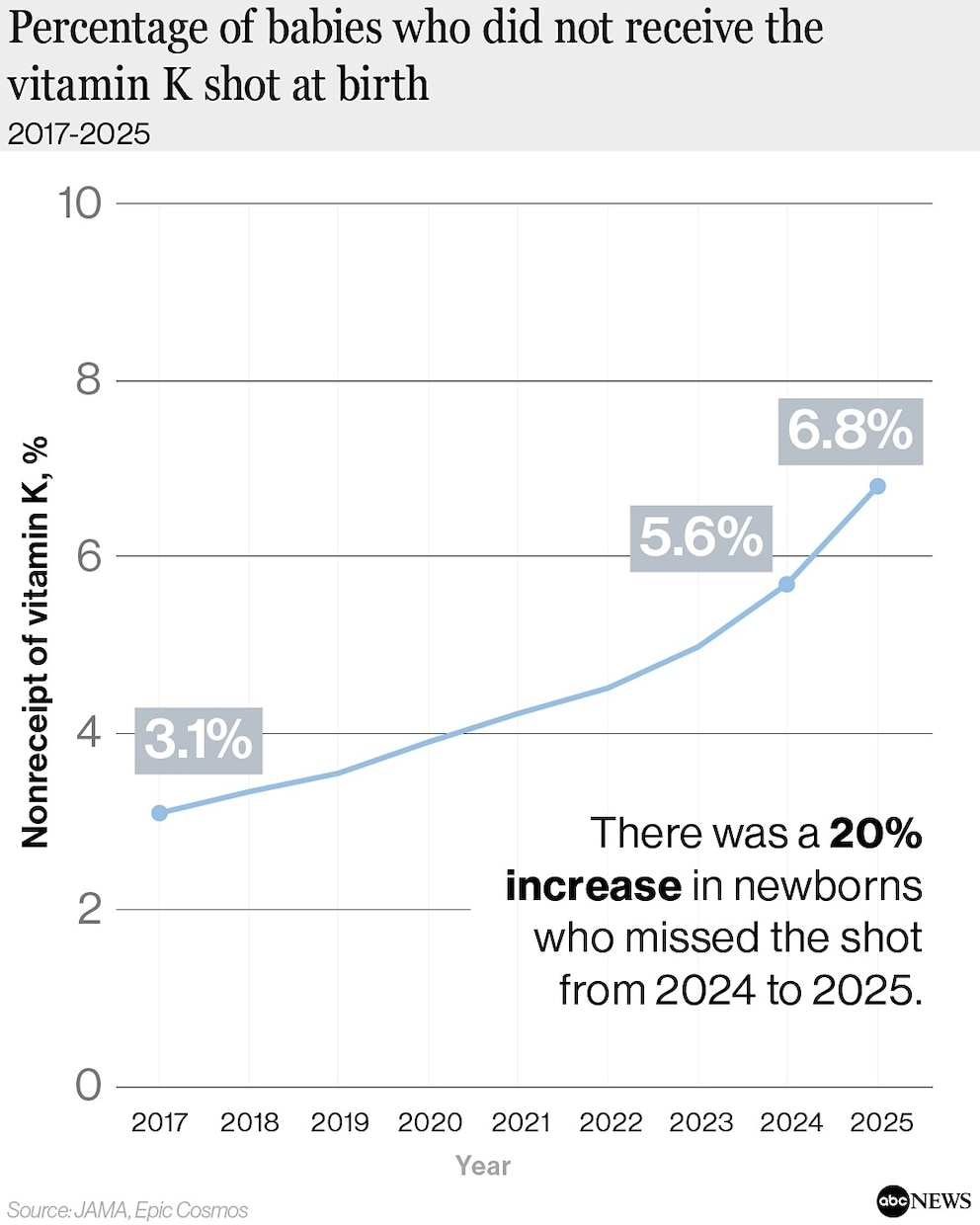
According to CHOP’s summary, the number of infants missing the vitamin K injection rose from 3.1% in 2017 to 6.8% in 2025. The researchers reported a 47% higher adjusted risk of recorded bleeding among babies without documented administration. That is a relative increase, not a claim that nearly half of those babies experienced bleeding.
“This is certainly evidence that more babies are not receiving vitamin K, and more babies are at risk of bleeding,” Dr. Kristan Scott, the study’s lead author and now an assistant professor of pediatrics at Children’s Healthcare of Atlanta and Emory University School of Medicine, told ABC News. Scott conducted the research as an NIH T-32 postdoctoral fellow at CHOP.
The findings add scale to what clinicians have been reporting anecdotally as more parents refuse the vitamin K injection at birth. Nurses working in labor and delivery, pediatrics, and neonatal care are often the first point of contact for families weighing the decision.
First and foremost, it is imperative that healthcare workers, parents, and patients know: It is a vitamin treatment, not a vaccine.


Want to see more Nurse.org articles in your Google results? Add us as a preferred source.

The JAMA study led by Kristan Scott, MD, MSHP, examined electronic health records for approximately 5.2 million hospital-born infants delivered at 35 to 43 weeks’ gestation. Researchers followed recorded outcomes through six months of age.
CHOP reported 288 bleeding events per 10,000 births among infants without documented vitamin K, compared with 186 per 10,000 among recipients. Recorded bleeding in or around the brain occurred at rates of 33 versus 13 per 10,000, respectively.
Those numbers need context especially for nurses not familiar with the injection.
The study’s composite outcome included several bleeding diagnoses, rather than only confirmed vitamin K deficiency bleeding. Its observational design identifies an association and cannot establish that missing the shot caused every recorded event.
The authors also identified limitations:
- Electronic records can contain errors
- Home births were unavailable
- Oral vitamin K use could not be determined.
The database lacked exact bleeding timing, severity, and cause. Missing documentation should not automatically be described as confirmed parental refusal.
Clinicians who care for newborns say the findings put a number on what they have been seeing at the bedside. Kevin Dysart, MD, a senior study co-author and attending neonatologist at CHOP, flagged the brain-bleeding differential in the CHOP announcement: “Babies who did not receive vitamin K had more than twice the risk of recorded intracranial bleeding, with 33 cases per 10,000 births compared with 13 per 10,000 among infants who received the injection. Death during hospitalization at birth in the presence of a bleeding diagnosis was also more common among infants without documented vitamin K administration.”
Dr. Thomas Patterson, an Idaho pediatrician of nearly 30 years, rarely had parents refuse the vitamin K injection until more recently. Before around 2022, Patterson told ABC News, vitamin K refusals were “very sporadic and rare, and they weren’t all-consuming.” The pace has picked up since. “There has been a significant uptick for me,” he said. “One day, I had 10 babies and five of them went out of the hospital without vitamin K.”
Vitamin K helps blood clot normally and prevents bleeding. Vitamin K does not cross the placenta during pregnancy and breastmilk/formula contains very low amounts. For that reason, it is essential for all newborns to receive the injection shortly after birth.
Newborns have low stores and cannot make or obtain enough on their own. The injection supplies protection against vitamin K deficiency bleeding, or VKDB.
It is a vitamin treatment, not a vaccine.
Babies affected by VKDB can appear healthy before bleeding begins. Bleeding can involve the brain, intestines, umbilical cord, or skin. Brain bleeding can cause permanent injury or death, making prevention especially important.
“Vitamin K is absolutely critical for our livers to make the clotting factors that help our blood clot,” Dr. David Hill, a hospitalist, pediatrician and spokesperson for the American Academy of Pediatrics (AAP), told ABC News. “What we’re really worried about is serious life-threatening bleeding … And often, by the time we figure out that bleeding is happening, it’s really too late to stop the worst consequences of it.”
The CDC’s guidance for healthcare providers says late VKDB can occur up to six months after birth, most commonly between two and eight weeks. In many cases, there are no warning signs before a life-threatening bleed.
Questions about preventive newborn care are also part of a broader conversation. In Associated Press reporting published in March 2026, clinicians described parents’ concerns about pain, safety, and conflicting information. They emphasized listening respectfully and addressing specific worries. That approach offers a useful starting point for a bedside conversation.
Start education early when possible. The CDC recommends discussing vitamin K during prenatal care, before parents reach the delivery room. Consider asking what families have heard, then explaining the purpose of the injection in plain language. It is important to remind parents that the vitamin K injection is NOT a vaccine. Vitamin K is often introduced at the same bedside visit as the hepatitis B vaccine, which contributes to the confusion. Nurses and other healthcare professionals should make the distinction clearly and early.
Many facilities delay or decline elective newborn procedures, including circumcision, when vitamin K has not been given. Follow your unit’s policy and loop families in on that decision early.
Nurses should invite questions and use teach-back to check understanding.
For families worried about losing bonding time, CDC guidance allows administration to be delayed up to six hours after birth to support immediate contact. Follow your facility’s orders and newborn medication procedures when discussing timing.
For discharge teaching, review potential warning signs, including unusual bruising, feeding intolerance, pallor, and a bulging fontanelle. Make clear that watching for symptoms cannot replace prevention because a serious bleed may develop without warning.
Nurses should document the education provided, the family’s decision, and actual administration status according to local policy. Escalate unresolved concerns to the newborn care team and include relevant information in handoff.
The new findings are a reason to revisit how your unit handles these conversations.
🤔 Nurses, what questions about the newborn vitamin K shot come up most often on your unit, and what helps families understand its purpose?
If you have a nursing news story that deserves to be heard, we want to amplify it to our massive community of millions of nurses! Get your story in front of Nurse.org Editors now – click here to fill out our quick submission form today!
Nursing Industry Research