Why Gen Z Nurses Are Leaving After 30 Months — and What Managers Can Do About It
A new report on Gen Z nurses has a finding that should get every nurse manager’s attention: to keep younger nurses engaged, they need about 2.5 times as many meaningful interactions as millennials, and up to 5 times as many as baby boomers and Gen X nurses, to achieve similar retention improvement.
That single data point, published for the first time in the Engaging and Retaining Gen Z Nurses: Trends and Strategies report from the American Organization for Nursing Leadership (AONL) and Laudio Insights, captures something nurses on both sides of the equation have felt for a while. Gen Z nurses want more connection, more feedback, and more transparency at work — and when they don’t get those things, they may be more likely to leave.
The Spring 2026 report draws on data from nearly 100,000 RNs across more than 150 hospitals and health systems nationwide, paired with in-depth interviews with 15 nurse executives and managers. It is one of the most comprehensive looks at Gen Z nurses in the workforce to date.
Gen Z Is Now the Second-Largest Group of RNs — and the Only One Growing
By mid-2025, Gen Z nurses were the second-largest RN generation in the report’s health system dataset — and the only one still growing. Their numbers rose each January and July, in step with nursing school graduations.
That growth is happening as millennial nurses — now mostly in their 30s and early 40s — are stepping back from acute care in noticeable numbers. Several nurse executives in the report said millennials are reducing hours or leaving hospital-based roles while raising young families, a trend worth watching for its implications for workforce sustainability.
For now, Gen Z is filling in, and fast.
The 30-Month Window: Good News and a Warning
Here is where the data gets interesting, and where nurse leaders should pay close attention.
Gen Z nurses actually have the strongest early-tenure retention of any generation. At the 24-month mark, 68% of Gen Z RNs hired in 2025 were still with their organization, compared to 61% of millennial nurses and just 41% of baby boomers. For the first two to two-and-a-half years, Gen Z nurses are more likely to stay than anyone before them.
Then the curve flips.
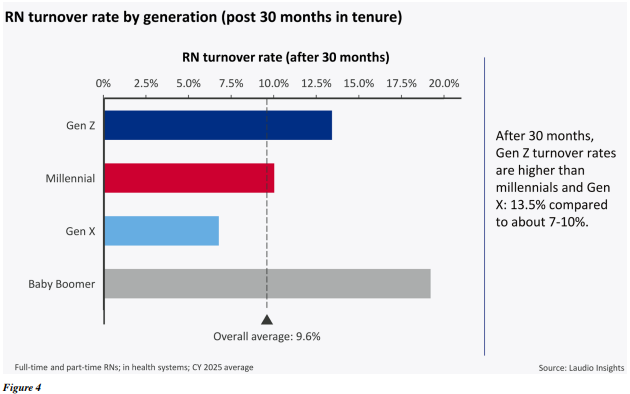
After 30 months on the job, Gen Z turnover climbs to about 13.5%, higher than both millennials and Gen X, who hover around 7 to 10%.

RN turnover rate by generation after 30 months in tenure. Source: AONL/Laudio Insights, Engaging and Retaining Gen Z Nurses: Trends and Strategies, Spring 2026
The report’s researchers point to a clear explanation: the first 30 months typically coincide with structured residency programs, intentional mentorship, frequent check-ins, and clear development expectations. Once those programs end, Gen Z nurses transition into standard workflows that were largely built around the expectations of older generations — and they start walking out the door.
“The data suggest that Gen Z RNs are not leaving because of an inability to adapt to nursing practice,” the report states, “but rather because the workplace model they enter after early tenure no longer provides the frequency of feedback, coaching, recognition and relational connection they experienced during residency.”
The most actionable number in the report comes from a statistical analysis of how manager-led interactions affect retention rates across generations. The researchers defined “meaningful interactions” as documented, work-focused exchanges — emails, texts, check-ins, notes or follow-ups — that go beyond casual small talk.
The finding: one meaningful interaction every three months produces no measurable retention benefit for a Gen Z nurse. Three interactions in a 90-day window are associated with about a 2.5 percentage-point improvement in retention. Five interactions bump that up to around 5 points.
For a millennial nurse, two interactions in that same window produce a similar retention lift. For baby boomers and Gen X nurses, just one interaction every three months yields a 5-point improvement.

RN dose-response curve of meaningful manager interactions on retention rate, by generation. Source: AONL/Laudio Insights, Engaging and Retaining Gen Z Nurses: Trends and Strategies, Spring 2026
The gap is significant. Nurse managers who continue leading the way they always have, checking in occasionally and relying on annual reviews, will get solid results with their older staff and meaningfully worse results with their younger ones.
As the report puts it: managers need “shorter, more specific and more frequent interactions with Gen Z RNs just to maintain a similar level of retention as they do with older RNs.”
This isn’t necessarily about Gen Z being high-maintenance. The researchers acknowledge the finding might reflect the broader feedback needs of younger people across all generations, not just a Gen Z-specific trait. But for nurse leaders today, the practical implication is the same either way.
>> Listen to The Latest Nurse News Podcast
Beyond the numbers, nurse executives and managers shared five priorities for engaging Gen Z nurses. Reading between the lines, each one reflects something nurses at every career stage can probably relate to.
- Personalize professional development. Gen Z nurses want to see a clear path from day one. They are not reluctant to take on leadership, the report found — they just want to know what “ready” looks like before they raise their hand. Nurse leader interviews revealed that when managers spell out specific competencies for charge nurse or specialty roles, rather than defaulting to seniority, Gen Z nurses step up. As one nurse leader in the report noted, “New grad Gen Z nurses want to see options and a path from the very beginning.”
- Adapt organizational structures and systems. Many of today’s workflows, scheduling norms, and performance review systems were designed for a workforce that no longer exists. Gen Z nurses notice quickly when policies contradict the values an organization claims to hold. One nurse leader in the report put it plainly: “Our task is not to make Gen Z fit the system we inherited, but to reshape that system around the workforce that will lead it into the future.”
- Modernize communication. This generation views email the way older nurses might view a fax machine. The report cautions, though, against assuming Gen Z only wants to communicate digitally. Nurse leaders were clear that face-to-face, one-on-one conversations with managers remain central to how Gen Z nurses build trust. The goal is multi-channel communication, not screen-only connection.
- Prioritize wellness and flexibility. Gen Z nurses are more likely to cluster shifts to maximize consecutive days off — a scheduling pattern the data confirmed statistically. They are also less likely to skip breaks or clock in early, behaviors that prior AONL/Laudio research has linked to burnout risk. Rather than viewing this as a lack of work ethic, the report frames it as a different and arguably healthier relationship with sustainable practice. One nurse leader observed: “With every career decision, Gen Z weighs the opportunity against the potential impact on their mental health and wellbeing, which is different from prior generations.”
- Advocate for mental health. Gen Z nurses are more open about emotional strain than previous generations and less willing to treat burnout as an unavoidable occupational hazard. The report calls on organizations to treat wellness as a structural issue — staffing, workload, and access to resources — not just an individual one. If you’ve seen recent data on Gen Z nurse burnout rates, this tracks: more than one in four Gen Z nurses report feeling burned out every single day.
Whether you are a new nurse navigating your first few years on the floor, a charge nurse figuring out how to work with younger colleagues, or a manager trying to hold a team together amid ongoing staffing pressures, this report has something direct to say.
- For Gen Z nurses: your expectations for feedback, transparency, and a clear career path are not unreasonable. They are, increasingly, backed by data. Advocating for those things at your organization is legitimate and worth doing.
- For nurse leaders and managers: the gap in retention after 30 months is not inevitable. The report points to a specific, addressable cause — and a specific, manageable fix. More frequent, shorter, work-focused conversations with your younger staff can make a measurable difference in whether they stay.
As one nurse leader in the report summarized: “Organizations that have not meaningfully invested in their nurse managers will face significant challenges in engaging and retaining Gen Z nurses.”
For more on nurse burnout warning signs and what organizations are doing about them, see our earlier coverage of AONL and Laudio’s Fall 2025 research. And for a broader look at how Gen Z is already reshaping nursing culture, we have that covered too.
🤔 What do you think about this new research? Tell us in the comments below.
Nursing Industry Research
-
Published on
May 12, 2026
Written by