This AI-Enabled Security System Just Launched a Way to Scan Ambulance Patients for Weapons
Most hospitals have some kind of security screening in place for visitors—but what about the patients? When a patient is brought in by ambulance in an emergency, does anyone know what’s on that stretcher? What if they had a weapon on them and in the chaos of stabilization, the medical team missed it?
Athena Security, an AI-forward security system management and resource, is aiming to improve hospital security and reduce workplace violence, even at the ambulance bay level. The company just introduced the first AI-powered ambulance bay security scanner—and the response has been overwhelmingly positive.
Although Athena is already widely used for security and threat detection in hospitals nationwide, their newest AI-enabled security feature is pretty incredible: it scans patients in real time as they are brought through the hospital on an ambulance stretcher to identify and locate if the patient has any weapons on their person.
“There’s not a successful system to date, until now, that works in the ambulance bay,” Chris Ciabarra, co-founder and CTO/Chief AI Officer of Athena, explains.
And why is that?
Because everything on the stretcher is already metal, a metal detector will not pick up a weapon. Athena’s new scanner uses special imaging radar to see past the metal and detect and identify if the person on the stretcher has a weapon.
The way it works is simple: as soon as the patient comes off the ambulance, they are scanned, conscious or unconscious, as the stretcher passes under the bay, for seamless and continuous security that doesn’t interfere with patient care.
The ambulance bay weapons detection system is expensive, with a price tag of somewhere around $200,000, but Ciabarra stresses that the system is meant to support healthcare workers in what they do best: save lives, safely.
“Our mission is to help save lives, and that’s what we’re there to do,” he says. “We’re coming out with new technologies to secure the entryway. No one had an ambulance base detector before we created it. A lot of weapons come through the ambulance, and it’s a big problem for hospitals, so we secured that.”

Source: Athena
Athena Security also offers the Apollo 500, an AI-powered concealed weapons detection system that utilizes 5-8 AI agents who scan, detect, and monitor for weapon threats in hospital and healthcare facility settings. Unlike traditional entry-point threat detection systems that may employ a basic scanner and one or two security guards, Apollo 500 can provide continual, fatigue-proof, checkpoint and visitor monitoring and threat detection.
If a threat manages to get through one detection point, having 5-8 other AI agents cross-check helps further eliminate the risk of it reaching the hospital. The patent-pending AI Agent framework works across an entire Weapons Detection System, including Visitor Management, Weapons Detection, and X-ray.
As Ciabarra explains to Nurse.org, hospitals using Apollo 500 can choose from the recommended AI agents that the system includes, or create their own custom agents to match their visitor flow. Ciabarra also explains that the information the Apollo 500 provides to security teams at the hospital is key.
“The data they get to make a decision is really beneficial to them,” he explains. Data that Apollo provides includes things like a threat alert, weapon location, and what material the weapon is made of.
“That’s really important,” he adds. “Why? Because you’re making a split-second decision. So the more data you have on that subject, the better. When you have that data point in there to be viewed, it really helps you make a split-second decision, a more accurate one.”
Ciabarra also provides a very specific example of how an AI detection and monitoring system can be far more advantageous than just a threat removal system. If a traditional scanner detects a gun, for instance, the gun is either removed or the individual and the gun are denied entry to the building. But with the Apollo, both the gun and the individual can be logged and detected with further admission attempts, or in the unfortunate event of a threat escalation.
“Others stop at detection, but that’s where we begin.”

“We put options on the system,” he continues. “Now you can quantify the deterrence factor. When someone sees a system and walks away, you don’t capture the gun because they didn’t go through the system, so you don’t know they had it. But if they come up to the system and walk away, you ask them a question, like, ‘Yeah, I’m putting the gun back in my car, sorry.’ And then you have no way to know that happened. So now you can quantify that on our platform. So that’s a big thing. Hospital administrators can get all the data and actually understand how many weapons are coming to their facility.”
More effective threat detection systems are becoming more important than ever, especially with new hospital entryway mandates such as California AB 2975 taking effect in 2027.
>>Listen to The Latest Nurse News Podcast
According to Athena, their AI agents each handle an automated piece of the security workflow, handling the high-frequency repetitive tasks to free up human personnel to “prioritize situational awareness and response.
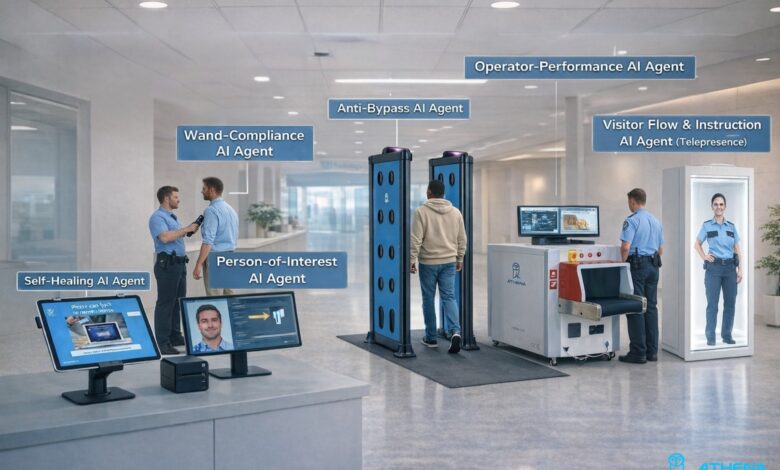
There are six built-in AI agents, although custom agents can be built as well:
- Person-of-Interest AI Agent: scans anyone trying to enter against external watch lists and anyone who has been flagged in the system.
- Wand-Compliance AI Agent: verifies that secondary wand screening is performed correctly and consistently.
- Anti-Bypass AI Agent: detects and alerts if a visitor attempts to walk around, evade, or improperly pass through the screening system.
- Operator-Performance AI Agent: The Operator-Performance AI Agent monitors that the WDS system is being operated according to established procedures, helping reduce drift, shortcuts, and fatigue-related errors
- Self-Healing System AI Agent: monitors system health, alignment, and alerts a human if intervention is needed.
- Visitor Flow & Instruction AI Agent: a holographic agent that directs visitors through the security checkpoints.

Source: Athena
Whether it’s through checkpoint screening or ambulance bay screening, Ciabarra is adamant that nurses deserve better systems that help protect them at work and that Athena is just one solution to help make that happen.
“We’re building technologies to build a better future,” he says.
If you have a nursing news story that deserves to be heard, we want to amplify it to our massive community of millions of nurses! Get your story in front of Nurse.org Editors now – click here to fill out our quick submission form today!
-
Published on
May 11, 2026
Written by