What Pope Leo XIV Just Said About AI Speaks Directly to What Nurses Already Know
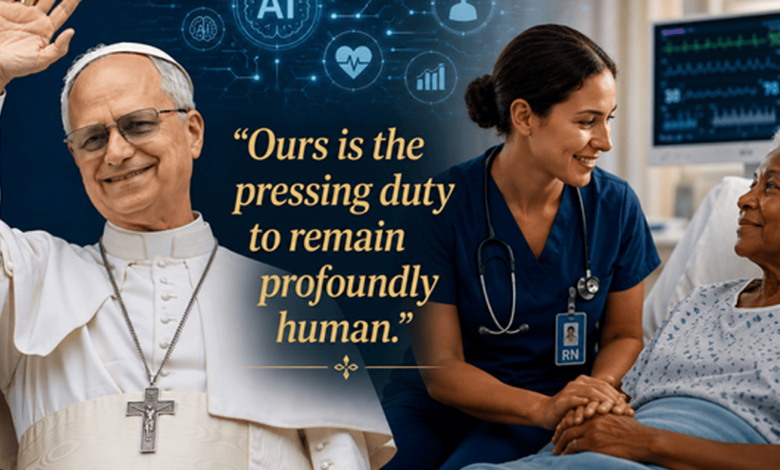
Image source: The Vatican
On May 25, Pope Leo XIV released Magnifica Humanitas — Latin for “Magnificent Humanity” — his first encyclical as pope, published in the final days of Nurses Month. An encyclical is a formal letter issued by the pope to the Catholic Church and, in this case, explicitly to “all men and women of goodwill,” intended to address a major question of the era. This one is about artificial intelligence, and it is one of the most significant moral statements on the subject issued by any religious or civic authority to date.
Its core argument belongs to anyone who has ever stood at a bedside and felt the weight of what it means to care for another human being.
The encyclical opens with a choice the pope says every generation faces: whether to build a “Tower of Babel” — impressive, unified, and ultimately inhuman — or to build something that actually serves people. He frames artificial intelligence as the defining version of that choice for our era.
“Technology has the power to heal, connect, educate and protect our common home,” he writes, “but it can also divide, exclude and generate new forms of injustice.”

That is not a rejection of technology. Leo XIV is careful to say that AI, in itself, is not the enemy. What concerns him is what he calls the “technocratic paradigm” — a tendency to let the logic of efficiency, control, and profit alone shape decisions that should be guided by human values. In healthcare, that paradigm is familiar: staffing ratios determined by acuity algorithms, discharge timelines driven by bed utilization dashboards, documentation requirements that pull nurses away from patients and toward screens.
The encyclical puts a name to what many nurses have felt but struggled to articulate: the system is increasingly designed around data and throughput, not people.
One of the encyclical’s sharpest passages addresses the risk of reducing human beings to measurable outputs. Leo XIV warns against what he calls the “Babel syndrome” — including “the pretense that a single language — even a digital one — can translate everything, including the mystery of the person, into data and performance.”
For nursing, that sentence carries specific weight. A patient’s pain score is a data point. Their fear at 3 a.m. is not. The therapeutic relationship built over a long shift cannot be captured in a chart. The encyclical insists these things are not inefficiencies to be optimized away — they are the point.
“In the era of artificial intelligence,” Leo XIV writes, “when human dignity is threatened by new forms of dehumanization, ours is the pressing duty to remain profoundly human.”
That concern has roots in how Pope Francis, Leo XIV’s predecessor, described nursing in 2018, when he called nurses “experts in humanity” — crediting a nurse named Sister Cornelia Caraglio with saving his own life by overruling his doctors. Leo XIV’s encyclical is, in many ways, a theological argument for why that kind of judgment still matters.
>>Listen to The Latest Nurse News Podcast
A Direct Warning About AI and the Workplace
The encyclical devotes significant attention to what AI-driven automation means for workers — and it does not soften its position. The document argues that “the pursuit of greater profits cannot justify choices that systematically sacrifice jobs,” and that every introduction of automation should come with genuine commitments to protecting workers and retraining them.
It goes further, warning that AI can force workers to adapt to the speed of machines rather than the reverse — deskilling them, subjecting them to automated surveillance, and locking them into rigid, repetitive tasks. For nurses navigating AI-assisted clinical decision tools, automated monitoring systems, and ever-expanding documentation requirements, this is not an abstract concern.
The encyclical also raises a question worth sitting with: what happens to a profession — and to the patients served by that profession — when human judgment gets overridden often enough that it atrophies?
One of the encyclical’s consistent themes is what Catholic social teaching calls the “preferential option for the poor” — the idea that the moral quality of any system is measured by how it treats its most vulnerable members. The document explicitly names the sick alongside the poor, migrants, and the elderly as those whose dignity cannot be treated as secondary.
This framing matters for nurses not just philosophically but practically. Nurses are often the last line of advocacy for patients who are frightened, confused, or unable to navigate complex systems on their own. The encyclical makes a moral argument for what nurses do structurally: stand between an institution and a person, and insist on the person.
Perhaps the most pointed line in the document is also the most direct. The encyclical calls on people not to be “passive spectators” or “mere commentators on what is crumbling,” but to actively shape what comes next.
The document has drawn predictable political reactions — debate over its critique of markets, its warnings about corporate AI power, its position on autonomous weapons. Those conversations will continue. But for healthcare, the more urgent question is practical: who gets to define how AI is used at the bedside, and by what values?
Nurses are not observers in that conversation. They are implementing these tools, adapting to them in real time, and in many cases pushing back against versions of them that compromise patient care. The encyclical frames that kind of active engagement as a moral responsibility, not just a professional one.
Leo XIV signed the document on May 15, the 135th anniversary of Rerum Novarum, Leo XIII’s foundational 1891 letter on the dignity of labor during the Industrial Revolution. The parallel is intentional. What Leo XIII said about wages, working conditions, and the humanity of workers during the rise of the factory system, Leo XIV is saying about personhood and human care during the rise of the algorithm.
Nurses have been making a version of that argument at the bedside for a long time.
🤔 What’s your experience with AI at the bedside — is it supporting your judgment or replacing it? Share your thoughts in the comments below.
If you have a nursing news story that deserves to be heard, we want to amplify it to our massive community of millions of nurses! Get your story in front of Nurse.org Editors now – click here to fill out our quick submission form today!
-
Published on
May 29, 2026
Written by
Nurse.org Staff