UCLA Nurse Anesthetist Brings a Sound Bath Into the Operating Room, and Patients Love It
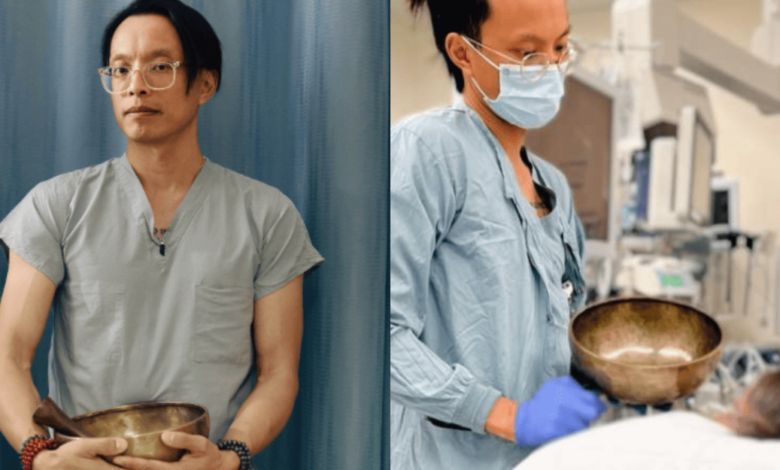
Image by UCLA Health
A nurse anesthetist at UCLA Health is rewriting the script on what the moments before surgery can feel like, swapping the standard pre-op routine for a Tibetan singing bowl, lavender oil, and a hand towel folded into a turtle.
Huy Vo, MSN, CRNA, has been quietly performing bedside sound baths for his patients at Ronald Reagan UCLA Medical Center and five other surgical centers since 2017. A longtime meditator and yoga practitioner, Vo says he started bringing his small metal singing bowl to work as a way to soften the clinical environment of bright lights, beeping monitors, and rushed introductions that often greets patients moments before they lose consciousness.
>>Listen to The Latest Nurse News Podcast
Vo’s approach has caught the attention of academic medicine. He has been invited to speak about his sound bath practice at Stanford University and at anesthesia conferences, and he was recognized at a recent California Association of Nurse Anesthetists event alongside fellow UCLA CRNAs.


Anecdotally, Vo says, he has noticed that patients require less medication when integrative modalities like sound, light, and lavender are part of pre-anesthesia care. He told UCLA Health he would eventually like to participate in a controlled study to verify those observations.
For Vo, the bigger pull is something harder to measure. “It really is about connection for me,” he said. “To be able to discover how I can feel a deep and profound connection with patients, and even my colleagues, on this energetic level, and even in a space (like the hospital), it’s everything. It just feels so nourishing and nurturing.”
Vo’s story is an unusual one, but the underlying question he is asking is one every nurse confronts: what do we do for the patient’s emotional state in the seconds before a high-stakes intervention?
For CRNAs and perioperative nurses, the research is clear that anxiety in the moments before anesthesia is not just a comfort issue. According to the American Association of Nurse Anesthesiology, the most effective strategies to ease preoperative anxiety include providing clear information, distraction, and thoughtful sedation when clinically appropriate. Sound, scent, and small acts of personalization can fit into that toolkit without slowing the OR down.
The story also lands at a moment when nurses across specialties are pushing back on assembly-line care. Vo’s line about not wanting patients to “get lost in what can sometimes feel like an assembly-line experience” will read as familiar to many bedside clinicians. Whether or not a singing bowl ends up in your OR, the broader move toward integrative, patient-centered touches is one nurse leaders, hospital systems, and patients are increasingly asking for.
If Vo’s planned controlled study moves forward and confirms what he is seeing anecdotally, the implications for sedation dosing, recovery times, and patient satisfaction scores could reach well beyond UCLA.
🤔 Would you ever try a sound bath, lavender oil, or a folded-towel animal with your own patients before a procedure, or do you think it crosses a line in a clinical setting? Tell us in the comments.
If you have a nursing news story that deserves to be heard, we want to amplify it to our massive community of millions of nurses! Get your story in front of Nurse.org Editors now – click here to fill out our quick submission form today!
-
Published on
May 29, 2026
Written by
Nurse.org Staff