A Nursing Instructor Asked an Auditor to Stop Filming A Student. He Refused.
As public filming incidents involving self-described First Amendment auditors increase, nurses face urgent questions about privacy, workplace safety, HIPAA, student protections, and what happens after the video goes online.
A Washington nursing instructor called security after a self-described First Amendment auditor filmed a student inside a classroom and refused to stop. Read the case files here.
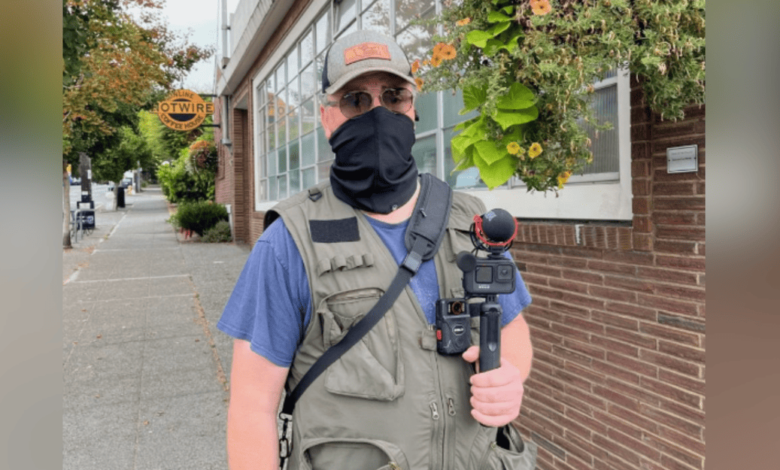
Video reviewed by Nurse.org appears to show a masked man carrying multiple cameras filming into a nursing classroom at Green River College while a student is working.
The nursing instructor approaches him calmly.
- “That’s a student,” she tells him. “You don’t have permission to film her.”
Moments later, she repeats:
- “She has not given me permission to film her.”
He refuses to stop.
Instead, he responds:
- “Oh, it’s totally okay. I already authorized it.”
Then adds:
- “Well, actually, the authority I have prevents her from having the ability to not consent.”
Only after that exchange does the instructor call security.
For nurses, the larger question extends far beyond a single incident:
What happens when First Amendment auditors begin filming in nursing schools, healthcare environments, or spaces where patient and student privacy concerns may exist?
Across the United States, public institutions increasingly appear to be grappling with exactly that question.
And many in Washington State are preparing for it.
During multiple interviews with Nurse.org, the man involved in the Green River encounter repeatedly identified himself the same way: “Steve McStevenson”.
When asked directly whether he had ever been referred to as Robert Anthony McDonell, he did not directly answer.
Instead, he repeated:
- “My name is Steve McStevenson.”
In separate interviews, he confirmed he was the individual present at Green River and identified Inland Auditing Media as the outlet through which he operates.
But public records independently reviewed by Nurse.org connect Inland Auditing Media, prior public-access disputes, and litigation to the name Robert Anthony McDonell.
In March 2024, Walla Walla police records obtained by Nurse.org document an “unwanted person” call at the Walla Walla Public Schools transportation office involving a man described as wearing a black mask, sunglasses, green clothing, and holding a camera. Dispatch notes indicate the individual was reportedly asking questions about “which buses were transporting certain kids.”
The report states the individual identified himself only as “Steve.” Responding officers later documented that the same individual again identified himself as “Steve” before being formally trespassed from district property.
The police report identifies that person as Robert Anthony McDonell. Video of that encounter was later published through Inland Auditing Media’s YouTube platform—the same outlet McStevenson identified to Nurse.org.
Subsequent police records indicate the district later agreed to lift the trespass effective April 1, 2024.
McDonell rejects the idea that he specifically targeted nursing staff. In interviews with Nurse.org, he said his Green River visit centered on government transparency reporting.
“My primary reason for being on campus was… sources reaching out with tips and leads that they weren’t following the Public Records Act.”
“I focus on the Public Records Act, the Open Meetings Act and some administrative law issues for government transparency purposes.”
He said nursing spaces were incidental to broader reporting.
“Nursing being one of them, of course, and that’s how I got into the nursing college area.”
But the public encounter itself unfolded differently.
When staff asked why he was there, he initially refused to explain.
“I can’t really get into that right now.” McDonell said.
When asked his name during the encounter, he responded:
“That’s Gandalf.”
According to the transcript, he repeatedly sought identifying information about faculty members, indicating he intended to pursue public records requests.
At one point, he referred to staff as “incalcitrant failures.”
He also stated:
- “I’m not here to be helpful. I’m here to get my business done.”
In interviews with Nurse.org, however, he described himself differently. “I’m an extremely polite individual. I don’t swear, I don’t yell, I don’t get angry. I’m a very calm regulated person.” he said.
He characterized staff reactions as emotional.
“They immediately jumped to an emotional response, predicated on fear.” McDonell said.
>>Listen to The Latest Nurse News Podcast
McDonell acknowledged to Nurse.org that his appearance is intentional.
In interviews, he confirmed he often wears a gaiter or face covering, sunglasses, a hat, and multiple recording devices during public encounters. Asked why, he said there are multiple reasons.
“There’s 3 reasons I wear a gaiter.”
He described the face covering as:
- A protest against facial recognition and government surveillance
- A political statement about Washington’s pandemic-era masking policies
- A deliberate way to provoke conversation
“I also use it to mock the Washington State government,” he said.
When Nurse.org raised concerns about how that appearance might be perceived by nurses and healthcare workers—many of whom are trained to assess potential threats amid rising workplace violence—he rejected the idea that appearance alone should shape those judgments.
“If someone has to make life-and-death decisions… and the only thing they’re going off of is their dress, their attire and preconceived notions, I think it speaks to a prestaged frame of mind,” he said.
For many nurses, however, the optics may land differently.
Healthcare workers face some of the highest workplace violence rates in the country, and many hospitals and educational institutions now train staff to rapidly assess suspicious behavior, unfamiliar individuals, and potential threats in patient-adjacent environments.
That tension—between constitutionally protected public filming and healthcare safety culture—is at the center of the debate.
The Green River incident is not an isolated event.
Videos publicly posted by Inland Auditing Media document visits to multiple Washington public educational institutions, including:
- Bates Technical College
- Clover Park Technical College
- Pierce College
- Tacoma Community College
- Olympic College
- Renton Technical College
- Green River College
- Walla Walla Public Schools
- Yelm Community Schools
Many of the videos show a recurring pattern: filming in public-facing institutional spaces, questioning employees about policies or public records access, and documenting staff responses for online publication.
Several of those institutions include nursing, allied health, or healthcare workforce training programs.
That breadth helps explain why administrators increasingly describe these encounters not as isolated controversies, but as situations requiring formal preparedness planning.
How Colleges and Public Institutions Are Responding to First Amendment Auditors
Green River is not the only Washington institution to describe these encounters as unsettling.
In Yelm, Superintendent Chris Woods publicly described a similar Inland Auditing Media encounter after a masked man identifying himself only as “Steve” entered the district office, filmed staff, photographed work areas, and sought public records information.
“I looked at our receptionist, and by the look on her face, I could tell that this was not OK.”
“You can imagine seeing somebody walk into your building looking like this is pretty unsettling.”
Woods said the encounter lasted more than an hour.
“Our receptionist can’t do any work… because he’s looking at her computer from around the desk, taking pictures of everything that’s going on…”
Following the encounter, Woods said the district changed procedures.
Green River described similar institutional changes.
The college told Nurse.org:
“Filming is generally protected under the First Amendment, and individuals may record what they can see from locations where they are lawfully allowed to be.”
But the college emphasized that restricted-access areas, FERPA protections, and privacy safeguards still apply.
Green River said it updated employee scripts, signage, and safety guidance after the incident.
Tacoma Police Records, Firearms, and Ongoing Federal Litigation
Public records reviewed by Nurse.org also document a separate Tacoma incident involving Robert Anthony McDonell.
According to Tacoma Police probable cause records, officers were dispatched to the Tacoma Landfill Recycling Center after reports of a masked man with a firearm taking photographs on the property.
The records identify that individual as Robert Anthony McDonell.
Police records state the facility was placed on lockdown after employees reported concerns about an armed, masked individual recording on site.
The probable cause declaration states officers later contacted McDonell wearing sunglasses, a balaclava-style face covering, and openly carrying a pistol while recording with multiple cameras.
A search incident to arrest documented:
- A Glock 17 handgun
- Loaded magazines
- Pepper spray
- Camera equipment
Tacoma prosecutors filed a municipal weapons charge related to that incident, though court records show the charge was later dismissed without prejudice.
The broader dispute did not end there.
McDonell later became the plaintiff in related federal civil litigation, McDonell v. Moore, involving constitutional and public-access claims arising from the Tacoma encounter.
That federal case remains ongoing as of publication.
Nurse.org independently reviewed federal court filings in that matter as part of its reporting.
Drone Filming, Patient Privacy, and Healthcare Concerns
Separate concerns emerged after Inland Auditing Media published drone footage near Western State Hospital, Washington’s state psychiatric hospital.
Video reviewed by Nurse.org appears to show aerial footage over areas that appear to be used for patient care.
Individuals who appear to be patients are also visible in portions of the footage.
In the footage, the on-site individual can be heard referring to himself as “Steve” multiple times.
When Nurse.org sought comment—including whether Inland Auditing Media operated the drone and questions about privacy concerns in a healthcare environment—the outlet responded via email signed “Steve.”
I.A.M denied ownership of the drone in an email to Nurse.org.
“As seen in the video with the tag of #NOTMYDRONE, that drone is not property of Inland Auditing Media, or operated by staff of Inland Auditing Media.” the organization stated.
I.A.M did confirm that staff were physically present on Western State campus that day.
When asked how the footage was obtained, the I.A.M declined to identify the source.
“Inland Auditing Media doesn’t divulge its sources of information unless approved by the source(s).”
I.A.M also stated it “works diligently to work within the confines of all applicable laws.”
For some institutions, the encounter itself may be only part of the story.
Inland Auditing Media’s public channel description states the outlet does not advocate call flooding, violence, or disruption.
But it also encourages viewers to “seek redress” and make complaints.
Its videos often generate large public comment threads.
Walla Walla Public Schools publicly stated that after its encounter video was posted, staff and school board members were:
For nurses, that raises a separate concern.
The issue may not end when filming stops.
McDonell’s activities do not appear to occur entirely in isolation.
In a recorded interview with Nurse.org, he acknowledged working with fellow Washington First Amendment auditor Seth Jameson Price.
Public reporting also documents overlap between the two.
The News Tribune reported that Price appeared in Inland Auditing Media-related content involving public-access disputes.
Price later faced criminal charges in a separate incident after allegedly pepper-spraying a married couple during a filming confrontation.
Those allegations remain unresolved unless adjudicated.
Price is not the subject of Nurse.org’s reporting regarding Green River.
But the documented collaboration illustrates the interconnected nature of some auditing channels—and helps explain why institutions increasingly prepare for future encounters.
For nurses, the legal reality is nuanced.
- HIPAA does not automatically prohibit private citizens from filming from lawful public locations.
- FERPA does not create a blanket ban on cameras across public college campuses.
- But healthcare environments are not ordinary sidewalks.
- Simulation labs, student clinical training spaces, instructional healthcare environments, and patient-adjacent settings carry legitimate privacy and safety concerns.
Public safety guidance increasingly emphasizes preparation—not confrontation.
- Stay calm
- Know public vs restricted spaces
- Identify operational disruption
- Avoid unnecessary escalation
- Involve supervisors/security early
- Protect patient/student information
- Document the encounter
For nurses, much of that guidance may feel familiar.
De-escalation, situational awareness, and protecting vulnerable individuals are already core healthcare competencies.
But one question matters:
The issue is often not simply:
“Can this person film?”
It’s:
- Are they lawfully in this space?
- Are they interfering with operations?
- Is protected information exposed?
- Are patients or students involved?
- Does behavior create a legitimate safety concern?
A camera alone does not necessarily mean unlawful conduct.
But neither should nurses ignore disruptive or threatening behavior.
As public filming culture expands, healthcare workers may increasingly find themselves navigating difficult split-second decisions where constitutional rights, privacy obligations, workplace violence concerns, and patient safety collide.
🤔 Nurses, share your thoughts in the comments below!
If you have a nursing news story that deserves to be heard, we want to amplify it to our massive community of millions of nurses! Get your story in front of Nurse.org Editors now – click here to fill out our quick submission form today!
-
Published on
May 21, 2026
Written by