“I Came Here With Two Suitcases and a Dream”: A Filipino Nurse on Immigration and Nursing
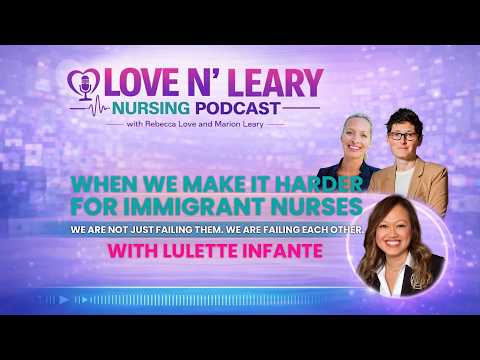
The views, thoughts, and opinions expressed in this episode belong solely to the hosts and guest and do not necessarily reflect the official policy, beliefs, or position of Nurse.org.
Lulette Infante was 18 when she landed in New York City. She had two suitcases, three younger siblings to help raise, and a plan to become a doctor. More than 30 years later, she’s a nurse informatics leader in Northern California… and she’s asking nurses to pay close attention to what’s happening to immigrants in health care right now.
On this episode of the Love n’ Leary Nursing Podcast, hosts Rebecca Love and Marion Leary sat down with Infante to talk about her journey from Manila, the family who made it possible, and the LinkedIn post that struck a nerve across the profession.
Want to see more Nurse.org articles in your Google results? Add us as a preferred source.

Infante was born in the Philippines and raised in Manila. She finished high school at 15 and had already started nursing school there when her family moved to New York in the early 1990s to join her father, who had been working in the U.S. for about a decade. Her mother, a teacher, had talked her out of medical school and into nursing as a pre-med path. She never left.
Her timing was rough. Hospitals in New York were closing and merging. Preceptors told new grads not to expect jobs. She took a part-time position at a children’s hospital anyway and stayed for 25 years… 13 of them in pediatric hematology/oncology, then ambulatory care, nephrology, and NIH-funded research. She was a founding member of that system’s pediatric kidney transplant program. She earned a master’s degree in nursing informatics and, before moving to California in 2021, led quality and informatics work across 25 primary care sites.
Today she’s a nurse consultant at a large Northern California hospital and president of the Northern California chapter of the American Nursing Informatics Association.
“I Came to This Country with Two Suitcases and a Dream.”
The LinkedIn post that brought her onto the show came after she read an article about nursing, immigration, and policy one morning before work. It made her think about patients who are now afraid to seek care at all.
She’s watched what that fear looks like from the inside. Children translating for parents in exam rooms. Patients missing appointments. People on strict chemotherapy schedules skipping the blood draws and treatments that keep them alive — not because of insurance or transportation, but because they don’t want to leave the house.
It reaches her own family, too. Her sons were born and raised in New York. When raids started happening near where one of them worked, she made him carry his passport. She carries her passport card everywhere she goes now, even flying between U.S. states.
Her broader worry is about who will be left to provide care. The U.S. population is aging, and Filipino nurses have been arriving in large numbers for decades to help fill that gap. If the pipeline narrows, she asks, who takes care of the rest of us?
Where the Hosts Landed
Love pointed to the history behind the conversation: the wave of Filipino nurses who came to the U.S. in the 1980s and 1990s and helped stabilize the workforce, and the share of today’s health care workforce that is foreign-born. It’s a group that has also drawn growing legal scrutiny of how foreign-educated nurses get recruited. Leary pointed to the nursing code of ethics, which repeatedly names advocating for and protecting vulnerable populations as a professional duty. Both framed their positions as personal ones, and both thanked Infante for taking on a topic that gets people yelled at online.
Infante’s own framing was blunter: nursing, she said, is political, because protecting patients sometimes requires saying out loud that something is wrong.
“You don’t need to be the loudest voice. You just have to be a consistent one.”
Her advice is small and specific. Learn the story of the person working next to you: the frontline nurse who practiced law in the Philippines for a decade, the nursing assistant who was a physician in Russia. Advocate for interpretation services and real informed consent instead of the quick hallway version. Notice who isn’t represented in the room and go find them.
And bring receipts.
“Data plus a story moves people.”
For nurses navigating this path themselves, Nurse.org has a full guide to working in the U.S. as a foreign-educated nurse.
Listen to the full conversation with Lulette Infante on the Love n’ Leary Nursing Podcast, or wherever you listen to podcasts.
If you have a nursing news story that deserves to be heard, we want to amplify it to our massive community of millions of nurses! Get your story in front of Nurse.org Editors now – click here to fill out our quick submission form today!
-
Published on
August 10, 2026
Written by
Co-written by