We Asked 1,500 Nurses When Their NCLEX Shut Off. Here’s What They Said.
We asked nurses across Instagram, Facebook, and LinkedIn one simple question: at what number did your NCLEX exam shut off?
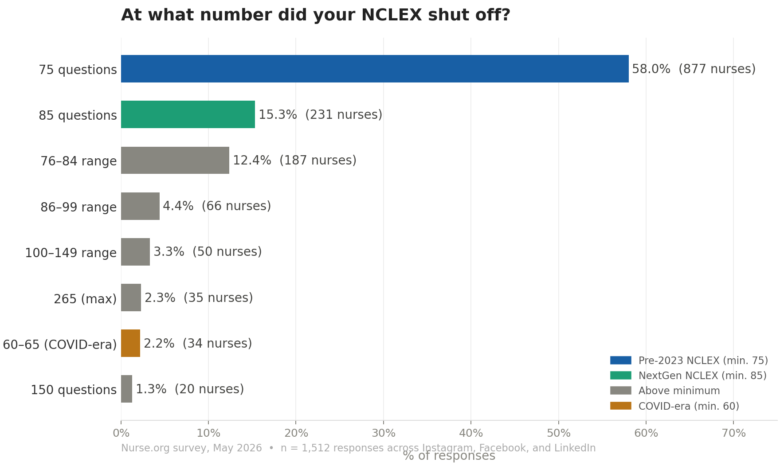
More than 1,500 nurses responded*. The answers ranged from 60 questions (the COVID-era minimum) to 265 (the current maximum) — and they came with stories that ranged from hilarious to heartbreaking.
Here’s what the numbers say, and what nurses told us about the terrifying moment the screen went dark.
Of the 1,512 responses that included a specific question count, nearly six in ten nurses reported stopping at exactly 75 questions, the minimum threshold that was in place from 1994 until the NextGen NCLEX launched in 2023.


Taken together, nearly three in four nurses (73.3%) reported their exam shutting off at either 75 or 85 — the two minimum thresholds representing the old and current versions of the test. That clustering at the minimum is one of the most striking findings in the data.
It’s also worth noting what this data is and isn’t. These responses are self-reported and not a random sample — nurses who had emotionally loaded experiences at the minimum cutoff were likely more motivated to share. Still, with more than 1,500 responses across three platforms, the patterns are hard to ignore.
One of the clearest signals in the data is generational. Nurses who tested before April 2023 overwhelmingly reported 75 as their stopping point. Nurses who tested more recently landed at 85 — the new minimum under the NextGen NCLEX, which replaced the previous computer adaptive testing (CAT) format.
The NextGen NCLEX introduced new question types, including extended drag-and-drop, trend items, and enhanced bowtie questions designed to assess clinical judgment rather than knowledge recall alone. The minimum question count rose from 75 to 85, and the maximum dropped from 265 to 150 for the RN exam.
Nurses in the comments reflected that shift directly.
- “2025, the max 150. Don’t be discouraged if it doesn’t shut off at 75! You can still pass and do well even if it takes you the whole five hours.”
- “NextGen in 2024, 85.”
- “85 (NextGen 2025).”
The data confirms the transition is real. Among nurses who mentioned testing in 2023 or later, 85 appeared far more frequently than 75 — a clean sign that the new minimum is becoming the benchmark the old one once was.
If there’s one theme that united nearly every response regardless of question count, it’s this: the moment the screen went dark, almost everyone assumed the worst.
It didn’t matter whether they stopped at 75, 85, or 150 — the reaction was the same.
- “75. I called my momma and told her I failed.”
- “75. I was terrified that I didn’t do well. Went home and turned off all the lights.”
- “75 and I panicked and screamed ‘but I wasn’t done.'”
- “265. Stayed the whole time. Passed first try. Never again!”
- “350, after the test I cried for four hours, vomited twice and then slept for two hours. Turns out I passed.”
The anxiety was not limited to people who stopped early. One nurse on LinkedIn described reaching question 75 or 76 and immediately flagging down the proctor when the screen went blank: “I broke every rule in the book and stated ‘ain’t no way, I worked too hard — you don’t know how I struggled for this.’ She frowned and motioned for me to follow her. At the door she said under her breath: ‘You passed.'” — Harry P, RN
Several nurses described physical reactions: hyperventilating in the car, crying in the parking lot, calling family members convinced they had failed. One commenter on LinkedIn wrote that after stopping at the minimum, she went home and “had a full blown panic attack with the lip tingling and hyperventilating” — before confirming she had passed.
The anxiety, it turns out, may be universal regardless of where the test stops.
>> Listen to The Latest Nurse News Podcast
The short answer from the data: not as much as nurses think.
Nurses who stopped at 75 passed. Nurses who went to 265 passed. Nurses who stopped at 75 sometimes failed. One LinkedIn commenter noted plainly: “What was the max again? That. And I passed. My best friend shut off at 75 and failed. You never know. Don’t let it deter you.” — Natalie H, RN
Joshua M, a VA nurse who took 265 questions, offered practical advice in the comments: “If you are a nursing instructor, do not prepare your students for having the test shut off at 75. Prepare them to receive the maximum number of questions, so they aren’t let down when it doesn’t shut off.”
The reason the question count doesn’t reliably predict outcome is baked into how computer adaptive testing works. The algorithm adjusts question difficulty based on each answer, and the exam continues until it achieves statistical confidence in whether the candidate is above or below the passing standard. Stopping early means the algorithm reached that confidence level quickly. Going longer means it needed more information — not that the candidate was performing poorly.
A Brief Nod to the Paper-and-Pencil Era
No question about the NCLEX would be complete without a chorus from nurses who predate the computerized format entirely. For anyone who tested before 1994, the concept of a screen “shutting off” is completely foreign — and they were happy to say so.
- “I had paper and pencil. It took eight hours a day for two days. Then I had to wait months to receive the results via snail mail. Thank God the envelope wasn’t thick.” — Carol D
- “Two days of sitting on metal chairs and filling in bubbles on paper at the Denver Merchandise Market. Then we waited eight weeks for results to come snail mail. Circa 1989.” — Dr. Denise S, DNP, RN
- “I took it in 1983 over two full days. And if you needed to go to the bathroom, you had to have a chaperone.” — M. Thomas Q, RN
- “You knew if you passed, or not, simply by the thickness of the envelope.” — Helena H, DNP, RN
- “Back in the day it was ‘shut off’ when you filled in the last little dot with your number two pencil.” — Joyce N
The paper generation is quick to remind everyone that waiting three months for a result in the mail had its own particular brand of anxiety — and that today’s two-minute quick results feel like a miracle by comparison.
If you’re currently preparing for the NCLEX, a few things stand out from this data and the conversations around it.
- The majority of nurses stop at the minimum. But that minimum is now 85, not 75. If you’re preparing under the NextGen format and your exam shuts off at 85, you’re in the company of the largest group of test-takers in our data.
- Going over the minimum is not a bad sign. More than 25% of respondents reported stopping above 85, and the vast majority of them passed. Several nurses who went to 150 or beyond noted they passed on the first try.
- The anxiety is part of the experience. Almost everyone leaving the testing center assumed they failed. That feeling is nearly universal and not a reliable indicator of outcome.
For a full breakdown of what to expect on the NCLEX — including how the NextGen format works, what question types to prepare for, and what to do if you don’t pass the first time — visit our NCLEX resource hub.
🤔 Tell us your story! At what number did your NCLEX shut off — and what did you do when it happened? Share your experience in the comments below.
*Nurse.org collected responses to the question “At what number did your NCLEX exam shut off?” across posts on Instagram, Facebook, and LinkedIn in May 2026. A total of 1,512 responses included a specific question count and were included in the analysis. Responses referencing paper-and-pencil format or without a specific number were excluded from quantitative analysis but are reflected in the article.
Nurse.org Quick Polls
-
Published on
May 5, 2026
Written by